
0

Inclusive language when talking about families - Blog - CPD Learning & Professional Development Tips at Laser Short Courses: Inclusive language when talking about families
Inclusive language when talking about families
Tuesday 14th January, 2025

Anyone who works in education will be in contact with the child or young person’s family, and will also talk to the child about their home life. It can be easy to slip into a habit of using ‘Mum and Dad’ if you grew up in a nuclear family, and even if you didn’t, you may say it out of habit if you’re influenced (as we all are) by the language those around us use. Many of us use non-inclusive language in our daily lives without thinking, and it doesn’t make us ‘bad’ or insensitive – we’re deeply influenced, often subconsciously, by our backgrounds and experiences – but it can be hurtful to those who aren’t being included in the language we use.
It's ok to make a mistake and correct yourself, or be corrected by someone else and learn something. What’s not ok is repeatedly making the same mistake and not reflecting on it or learning from it. It's important to stop and think about the language we’re using in our practice, and consider if we have any unconscious bias or pre-conceived ideas that may be making others feel judged, hurt, or not included. How do you think it would make a child who is being cared for by a foster family feel if you used ‘Mum and Dad’? How would a child in a single parent family feel? What about a child who lost a parent?
Words have power and this can be both positive and negative. How would those same children feel if you used ‘parent or carer’? Hopefully, they would feel seen, heard, and included. And would feel like you’re being considerate to different family structures.
The types of families we encounter, or may belong to, has changed considerably in the past century as attitudes to marriage, divorce, family life, and sexuality have also changed as we become a more tolerant society. There is still work to be done, but society is more accepting of different ways to live and understanding of people who have different lifestyles to our own.
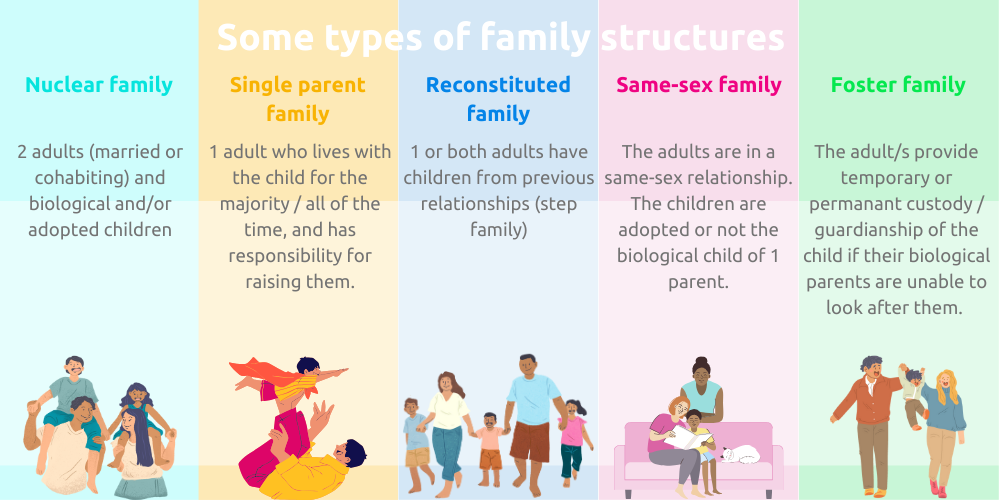
We are also seeing an increase in the number of children in care, with foster care being the most common placement type. A study published in The Lancet in 2022 concluded that 10,000 children entered the care system for reasons linked to poverty in the five-year period from 2015 to 2020. With the cost of living crisis and austerity cuts, the number of care in care is sadly, predicted to rise.
As such, we should be sure that the language we use when talking about families and home life includes every child in the classroom, no matter what their individual circumstance is. We want children and young people to feel safe at school or college, protected from discrimination, and for it to be a place where they are welcomed and included. A small action we can take here is to ask them for their preference on how they would like you to talk about their family, home life, and if they are in care, the terminology they prefer. If in doubt – ask!
Children in care
For example, many children feel that the official government term ‘Looked After Children (LAC)’ makes them feel different, stigmatised, and defined by care system language. According to the NSPCC, children in care are already particularly vulnerable to exclusion and discrimination from their peers and in the community, simply by virtue of being looked after. So, how we discuss and speak to children in care is particularly important.
Whenever we refer to a child by a label or acronym, we are grouping them together and not recognising them as an individual with their own unique experiences and characteristics. The acronym ‘LAC’ can be particularly harmful as it can make a child feel like they are LAC-king something, when they’re not. It also risks practitioners and educators seeing a child in care in a certain way, and making assumptions. Whilst it’s true that the experience of being in care can be traumatic and may affect the health, wellbeing, and development of a child, this isn’t true of all children in care.
Each individual's experiences and resilience will differ, and being a child in care doesn’t always mean that the child will struggle with some aspects of their development, such as emotional development. Many children in care form close relationships with their new families and carers, and other trusted adults, such as teachers and social workers, and with the right support they develop positive self-esteem, emotional regulation and awareness, resilience, and continue to thrive in adulthood. They can also develop healthy coping mechanisms, and are highly adaptable and determined to overcome challenges.
Tips for inclusive language:
• Use person-first language (such as a child in care), rather than identify-first language (A looked after child)
• Avoid labelling or using acronyms when talking to the individual or in the classroom. There is no need to mention a child’s family structure unless it’s relevant to the discussion. Understandably, you may need to use acronyms for ease and time when talking to other professionals and your colleagues.
• Challenge biases and reflect on the language you, your colleagues, the other children and young people, and the school uses
• Just as you would avoid assumptions about the child’s gender or sexual orientation, you should avoid assumptions about their parent/s or carer/s. This allows for people who identify as LGBTQIA+ to feel included.
• Avoid assumptions about biological parents and be mindful of the fact that some children don’t live with their biological parents, and may have experienced loss and bereavement. Instead of saying ‘Mum’ or ‘Dad’, consider using more neutral terms like ‘parent’, ‘guardian’, ‘caregiver’, or ‘carer’.
• Don’t assume the relationship status of the parent or carer – many people have children before marriage or civil partnership, and/or don’t plan to enter into a legal partnership. There are also many people who divorce or separate from the partner they had a child with, or choose to have a child as a single parent.
• Respect the privacy of children and their families and don’t force them to share details about their lives with you or their peers if they don’t feel comfortable doing so. If they do choose to share, encourage the class to actively listen, and be respectful and understanding.
• Recognise lived experience – there is a chance you may have a child in care at your school who was an unaccompanied asylum seeker or has refugee status. These children shouldn’t be defined by this.
• We may not always get it right, and what’s right for one person may not be for another. If in doubt – ASK!
If you would like to learn more about inclusive practice when working with children in care, you may be interested in our latest short course Children in care / Looked After Children in education.
References:
- ‘Child poverty and children entering care in England, 2015–20: a longitudinal ecological study at the local area level’ by Davara L Bennett, et. al, June 2022
- ‘Why language matters: why you should avoid the acronym 'LAC' when talking about children in care’ on the NSPCC website
- ‘Inclusive Language Examples: How to Be More Inclusive in the Classroom’ by Amie Jo-Angel, published on the TWINKL website